star trails
Star trails are the continuous paths of light from stars as they travel across the sky. Technically, it is our planet Earth which rotates on its axis. From our frame of reference though, it appears as if the stars are moving around us, much like the sun during the day travels from east to west.
Our eyes do not accumulate light, so when we look at the sky, we only see pinpoints of light at that particular moment.
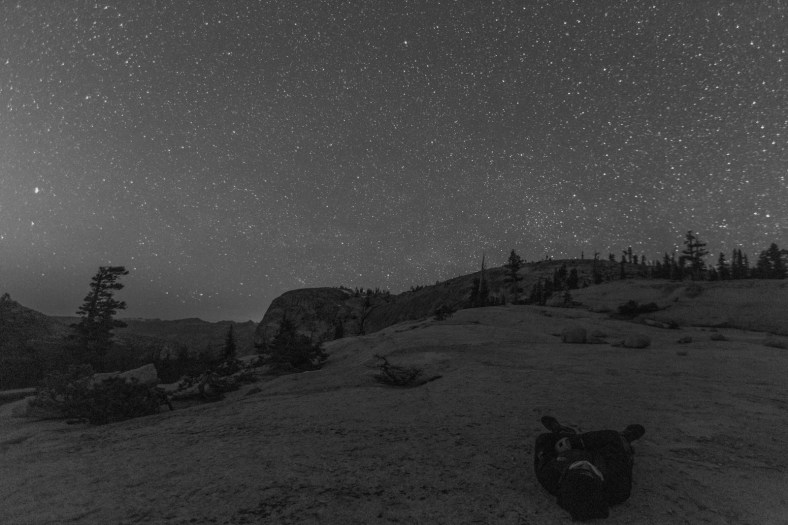
Yosemite, 15.0 sec @ f/4.0, ISO 12800
With a camera, we can collect the light emitted by the stars over a period of time (timed exposure) and create star trails.

Pear Lake, 60 min @ f/4.0, ISO 100
There are two methods to accomplish this. For example,
- Take a single shot with an exposure time of 60 minutes
- Take a series of shots at 10 second intervals over 60 minutes. You’ll end up with a total of 360 photos, which you then stack using software and create the star trails.
Method #1 requires less post-processing, but if a plane or satellite crosses through your frame, it will show up in your final photograph. If someone with a headlamp walks into your composed frame, it could ruin your work. Notice the horizontal streaks of light in the photograph below.
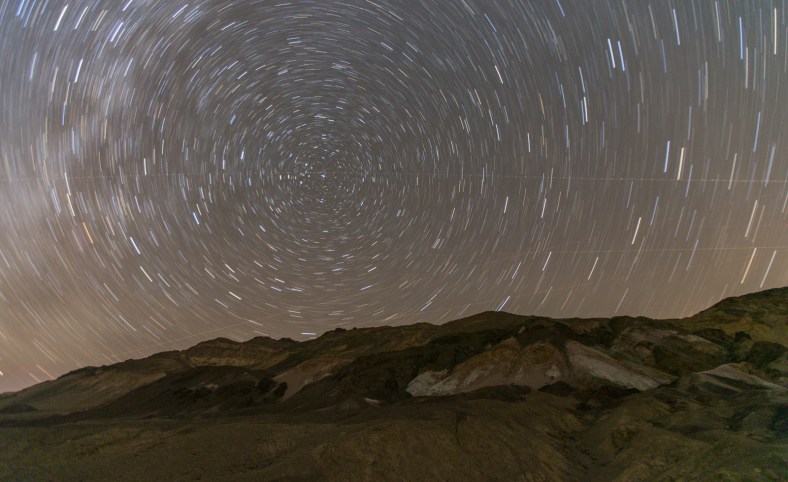
Death Valley, 20 min @ f/2.8, ISO 200
Method #2 will also capture light from the 2 incidents mentioned above, but it may only be visible in a handful of frames, say 10. You could delete these 10 frames and still have 350 frames to work with.
It takes approximately 24 hours for Earth to complete one rotation. From our frame of reference, the stars would complete a full circle in 24 hours. In one hour, each star will travel through a 15° arc. Compare the two photographs below, and note the size of the arcs. The first one was captured over 15 minutes, while the second one was captured over 40 minutes.
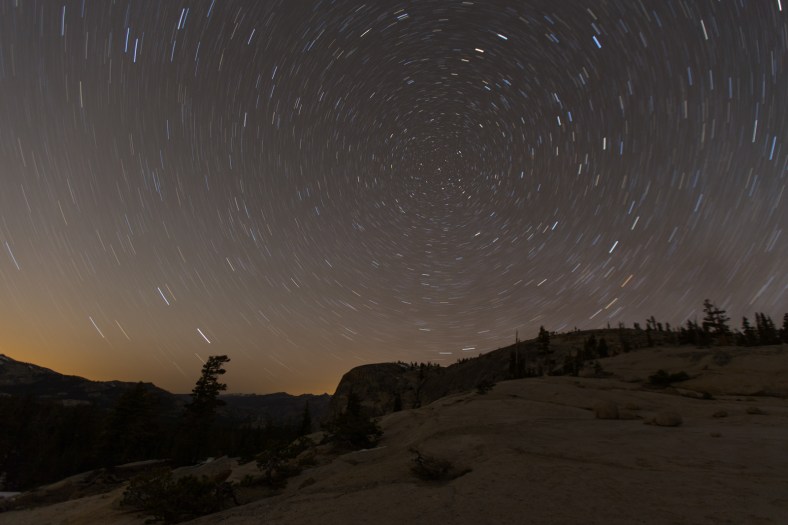
Yosemite, 15.0 min @ f/2.8, ISO 200
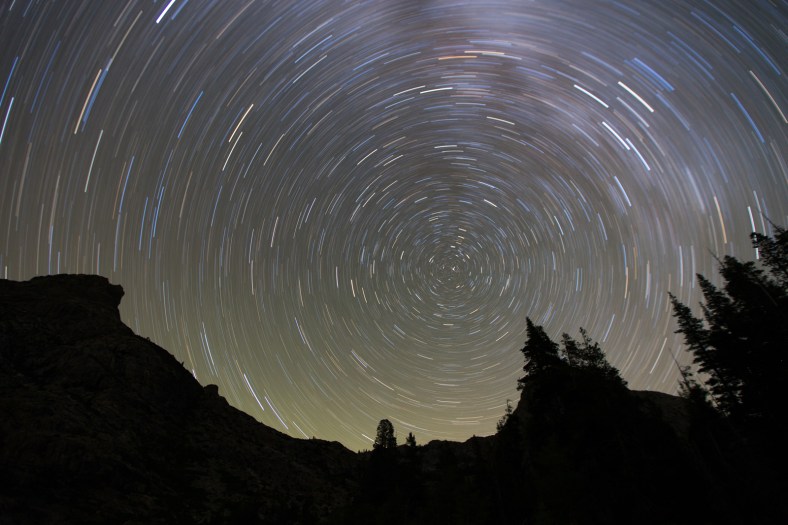
Piute Mountain, 40 min @ f/2.8, ISO 100
Polaris, the North Star, does not move. It will show up as a fixed point of light in a timed exposure. The stars closer to the poles create smaller circles. The stars closer to the equator create the largest circles.
taking the shot
To photograph star trails, you will need
- a camera with manual settings
- a wide angle lens in the 16-35mm range
- an intervalometer
- a sturdy tripod
These are the general steps I tend to follow when photographing star trails using method #2. Other sources exist for technical details on photography.
- select Bulb mode
- select manual focus, and focus on infinity
- set the aperture to f/2.8 (depending on the lens, it may be f/4.0. or other)
- select the highest ISO (25600 on my camera)
- set the exposure to 5 seconds
This provides me with a quick view of the composed frame which I can review on the LCD. If necessary, I adjust the focal length and camera orientation and snap another shot. I repeat this until I obtain the desired composition. After that,
- increase the exposure time to 60 minutes, for example
- reduce the ISO to compensate for the increased time exposure
- if necessary, adjust the aperture setting to compensate for the increased exposure
- set the shutter delay to 5 seconds to minimize vibration
- take the shot
post-processing
Depending on the lens and focal length selected, there may be distortion at the corners and edges of the captured image. I will crop the the photo to remove this distortion. I will also crop the image to obtain an aspect ratio, other than the standard 3:4, which will work better with the scene.
I also adjust the color to achieve the mood I want to portray in the photograph.

Death Valley, 10.0 min @ f/2.8, ISO 400
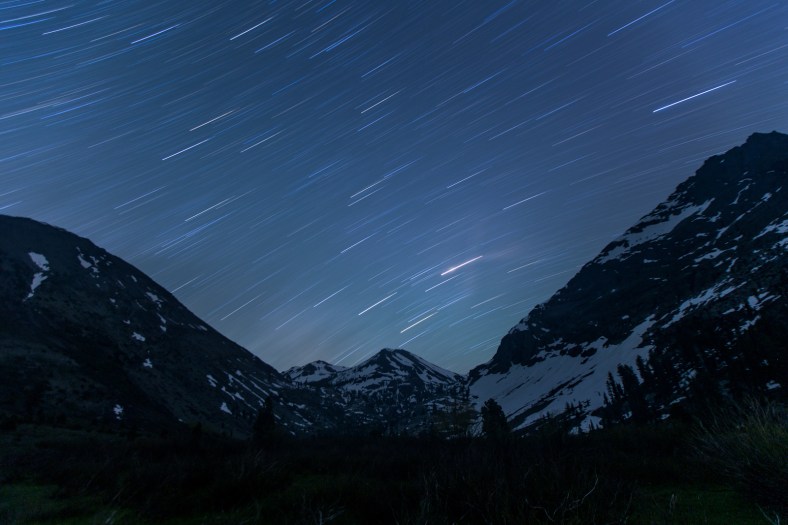
Kennedy Lake, 30 min @ f/3.2, ISO 200
parting thoughts
You will need to do some planning in advance to find a location of interest. Keep in mind that conditions will also change. When I set the camera for the photo below, the sky was clear, and the moon was below the horizon. While the photo was exposing, clouds rolled across the sky blurring the star trails and creating a hazy sky image. Note the dark patches above the horizon on the left of the image. Towards the end of the exposure, the moon had risen over the horizon, and it was illuminating most of the landscape.
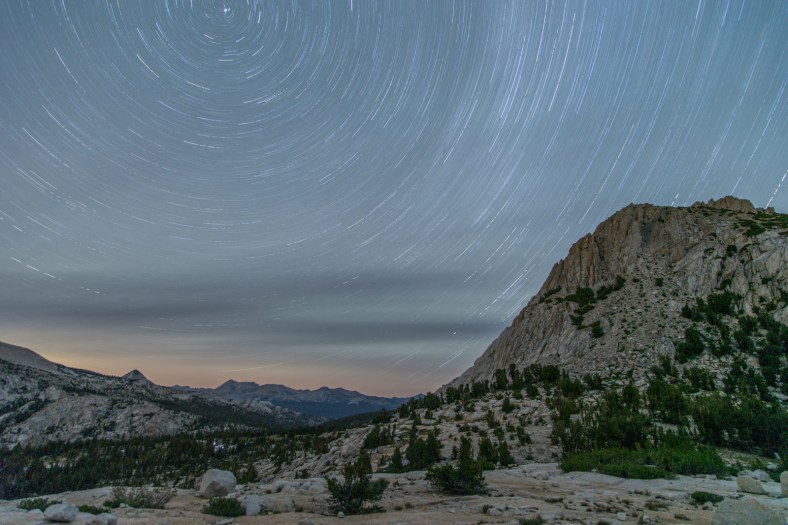
Star trails, Vogelsang Lake, 64 min @ f/4.0, ISO 200
There is no substitute for learning other than practicing and experimenting on your own. Review the photographs above, and use the camera settings as a reference for practicing. Have fun!
 pacorios